Events Attended

NYU Libraries & Institute for Public Knowledge: Digital Praxis: The Role of Libraries in the Digital Age

Attending a discussion between Siva Vaidhyanathan, the Director of the Center for Media and Citizenship at the University of Virginia, with Melissa Morrone, the Librarian at Brooklyn Public Library, and Vicky Steeves, Research Data Management and Reproducibility Librarian at NYU Libraries, about the role of libraries in the digital age. The mediator will be Shannon Mattern, the Professor of Anthropology at The New School. The event is part of Think in Public: Libraries in the Life of Cities and Communities, a series about the different roles that libraries can play in the lives of cities, individuals, and culture at-large.

Columbia University: Oral History Research

Attended two workshops pertaining to Oral History; Participatory Oral History and Politics and Trauma in Oral History. The workshops explored how the field of oral history supports research on immigration, migration, ethnicity, gender, politics, government and human rights. The first workshop was taught by Lynn Lewis and explored how to structure a participatory oral history research project, while advocating for social justice and change. Concepts such as authority, collaboration and co-creation were discussed. Lewis examined ideas of power and privilege dynamics in relation to relationships and information collection and analysis. The second workshop was taught by Zoe West and focused on how oppression, conflict and crisis arise within oral history and how these relate to effective and ethical documenting methods. 

SLA: Honored in the Breach: A Conversation about Data Privacy

Attended a panel discussion between Lucia Cedeira-Serantes, Assistant Professor at Queens College,Daniel Kahn Gillmor, Senior Staff Technologist, Speech, Privacy, and Technology Project at American Civil Liberties Union, Cassandra Porter the Director and Senior Privacy Counsel at Cognizant and Bonnie Tijerina, Researcher at the Data & Society Research Institute, led by Matt Johnson, about data privacy relating to vendors, libraries and advocacy. 

LibGuide: History of Family Separation

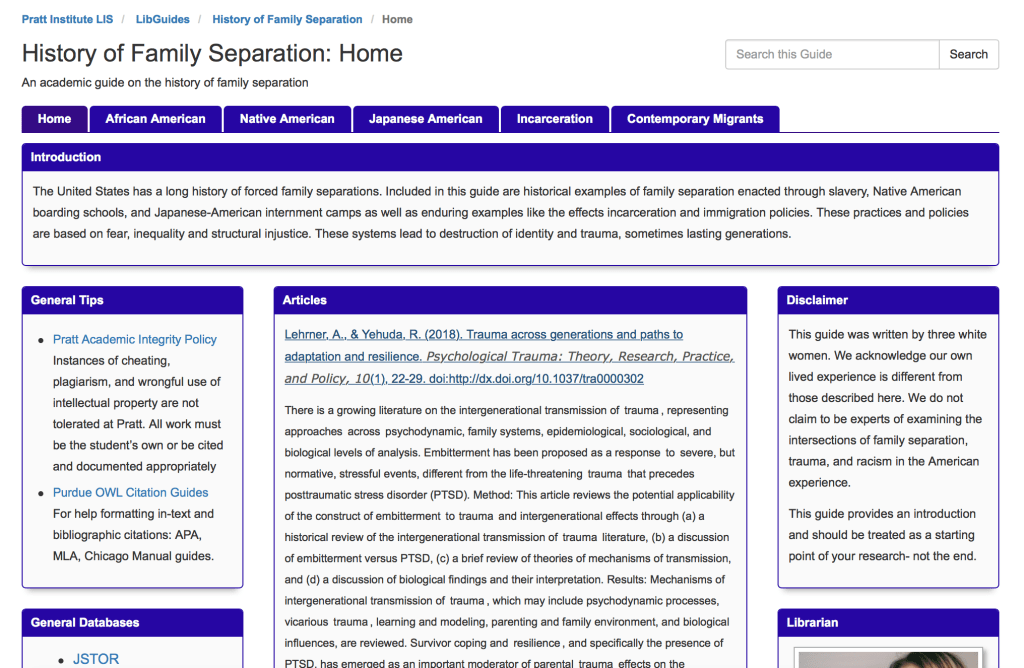
LibGuide: History of Family Separation

For this project I created a lib guide aimed to be the starting point for research into the trauma caused from family separation, specifically within the US, with 2 other students. Our group aimed at identifying which ACRL framework was expressed throughout the project as well as access the important and relevance of the items selected to be included on each tab.

Documentation of Street Art

Documentation of Street Art: How Crowdsourcing and Tagging are Changing the Landscape of the Digital Documentation of an Ephemeral Art

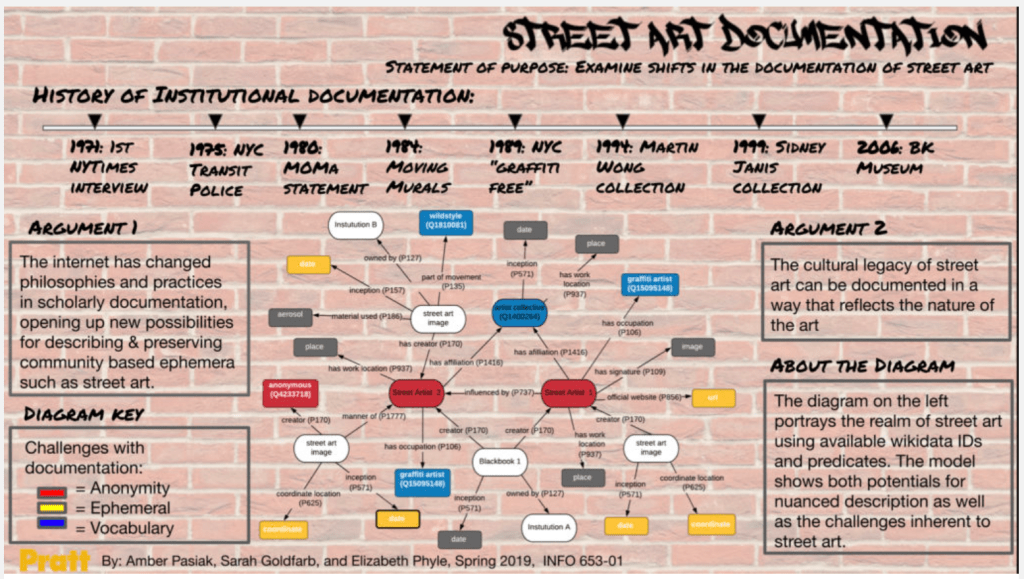
Street art documentation

For this project I worked with 2 other students to explore the ways in which crowdsourcing, the use of online tags and photography can help to create an environment that is not only conducive to document ephemeral street art, but also aligns with the nature of the art itself. This project explored ways in which information science philosophies and practices can aid in this movement from grassroots to institutions and corporations. 

Foundations of Information – 601

NYPL: Constraints Outside Bars

Nestled in an unassuming building on 39th street in Manhattan, lies the backbone to many of the programs offered through New York Public Library. One of these outreach programs is the Correctional Services. This program is a small staffed group of librarians and volunteers who help provide reference information, circulating book service, video visitation and recorded readings for children to people in jail. These are primarily New York state jails; however, the reach and depth of this program is rapidly expanding. It is here that I got a firsthand look at what it entails to run a program of this kind. I had the pleasure of meeting and spending the morning with Emily Jacobson, a Correctional Services Librarian. 

Before I went to do this observation, I read The International Federation of Library Associations and Institutions guideline for library services to prisoners which details practices that “reflect an acceptable level of library service, which could be achieved in most countries where national and local government policies support the existence of prison libraries.” This guideline stresses the shift from punishment to education and rehabilitation, wherein the role of the library is paramount. These guidelines offer hopeful, democratic and, which I was soon to discover, slightly unrealistic in practice, suggestions. This is not to say that the staff at NYPL has disregarded the suggestions, quite the opposite actually. I felt that they were doing their best to emulate them with what they were allotted. I also want to stress that I do recognize that a large general guidebook is going to have different uses across different institutions, whether it is a federal vs state jail or prison or a different type of correctional facility. 

The Day: 

Emily and I started the morning with a general overrun of all the services that are provided and how. The first task of the day was to sort through the many reference letters that have been mailed in. A great many of these letters requested a copy of NYPL’s “Connections” guide. This is a reentry guide that is free to people who are in jail or prison and offers information on housing and finding a job. Most of the other letters addressed issues about self-help resources, general reference questions and legal information. 

The second part of the day was the selection and shelving of books that have been donated to the program. The correctional services is a donation based service. This means that a lot of the books that are donated cannot be used for certain reasons. Although there is a very limited “banned” book list, a great many others were in too poor condition, repeats or, to my surprise, very out of date magazines. 

I was also surprised to learn that the program is all analog. Emily explained that there were several reasons for this. The first was that many of the jails do not have internet access, hence why this program’s reference letters were so popular, and there are many safety procedures in place that would make carrying out a regular library check out difficult. Another reason is that there are very few library locations inside jails, and thus the library will either be a popup that happens roughly twice a month or a book cart service. Some of the jails do offer some storage space, but when everything is in constant transit it makes hard to keep track of most of the books, as checking out a book is a hand-written paper process, with just a title and a patron name. 

Keeping track of the books while working in a jail is the sort of dilemma that a regular library doesn’t normally see. As Emily explained to me, a jail is where someone is either awaiting trial, or has been sentenced for less than a year. This means that the patrons to a library jail are very often in flux and books tend to go missing or get lost, making it nearly impossible to have a traditional check out system. 

The Days Reflections:

Although I spent most of the morning doing physical aspects of the job, it wasn’t hard to see how the theoretical frameworks that have been discussed in class were in play. The first that struck out to me was the curating choices of the librarians. As this is donation based, the variety of books coming in was already limited, and then the books about bomb making, etc. (if any) had to be removed, any damaged or watermarked books could not be used, and any hard cover books were deemed physically dangerous. So, what does this leave you with? Well, it looked to me that it was a million copies of the same Jo Nesbo and Nikki Turner books. 

How does a librarian deal with trying to offer a balanced selection with limited resources and restrictions? How does a librarian take hold of their accountability, responsibility and recognize their “power” in a much stricter and limiting politized institution? Reference letters and book requests do show how a librarian might try to build a certain collection, however, this is not always possible to do, due to funding, donations and general stigmatization of the rights owed to a person in jail. When do these critical questions about a library space overlap or go against the critical questions about the roles jails and prisons play in society? William Birdsall articulates in his article “A political economy of librarianship?” that: “librarians need to devote more effort researching the political and economic dynamics that define the past and current environment of libraries. Libraries are the creation and instrument of public policy derived from political processes.” Could this also not be said about jails and prisons?

In the article, “Information needs in prisons and jails: A discourse analytic approach”, the authors Debbie Rabina, Emily Drabinski and Laurin Paradise state that the information needs of people in prison and jail are actually constructed and created by those institutions. This article was written using data from the actual reference letters that NYPL correctional services have received. The article goes on to talk about the term digital divide. This term, otherwise referred to as information poverty, has been contested due to the binaries that it creates and simplification and stigmatization that it reinforces. They state that creating binaries related to the digital divide can be dangerous by placing librarians in a higher viewed position of power. They argue that the problem of information access is not solely the result of a lack of internet. 

I found this point interesting due to the already existing idea that people in jail or prison are coming from a place of poverty and that by placing them in a binary of digital divide, scholars are reinforcing that separation, while also adding another level of authoritative power above them. 

Conclusion:

Although I do not have an answer to many of the questions I have raised here, I did find it enlightening to have seen how some of the critical questions and theoretical frameworks we have been introduced to as students fit into real world situations. My day spent at the NYPL correctional services has made me think about these questions in a different manner. There has already been much discussion on how some of these issues of power play out differently between public and academic libraries, however when dealing with a public library situated in a very specific authoritative politized institution they take on another new role. 

“Future research should address the information that incarcerated users have, not what those of us on the outside imagine they do not.” (Rabina, 2016.)

Resources:

American Library Association. (2017) “Prison Libraries”. Retrieved from http://libguides.ala.org/PrisonLibraries/Home

Birdsall, W. (2001) “A political economy of librarianship?” Progressive Librarian, 18, Summer 2001. Retrieved from https://lms.pratt.edu/pluginfile.php/828932/mod_resource/content/0/02_Birdsall_2001.pdf

Lehmann, V., Locke, J., & International Federation of Library Associations and Institutions, T. H. (Netherlands). (2005). Guidelines for Library Services to Prisoners. 3rd Edition. IFLA Professional Reports, No. 92. International Federation of Library Associations and Institutions. Retrieved from https://files.eric.ed.gov/fulltext/ED497652.pdf

Rabina, D., Drabinski, E., & Paradise, L. (2016) “Information needs in prisons and jails: A discourse analytic approach.” De Gruyter. Retrieved from https://lms.pratt.edu/pluginfile.php/829457/mod_resource/content/0/2016_Libri.pdf

Foundations of Information – 601

Exile Consortium and Information

On September 6th of 2018, I attended The New University in Exile Consortium at The New School, in Manhattan, New York. The New University of Exile describes itself by stating that: 

“We are an expanding group of universities and colleges publicly committed to the belief that the academic community has both the responsibility and capacity to assist persecuted and endangered scholars everywhere and to protect the intellectual capital that is jeopardized when universities and scholars are under assault.”

The New School has a long history of helping refugee scholars. Starting in 1933, The New School’s first president, Alvin Johnson, created the first University of Exile. During the rise of Nazism and the increasing threat of intellectual prosecution, Johnson hired many European scholars as the Graduate Faculty of Political and Social Science. Johnson firmly believed that universities had to play a pivotal a role in protecting independent thought and research. He believed that it was a unendangered university’s responsibility to assist other universities that are under assault.

The New University in Exile has begun working again internationally with Scholar Rescue Fund, and Scholars at Risk, in the midst of new political and military attacks on scholars. In places like Turkey, Iran, India, Yemen, and Syria, universities are being weakened, shut down, and destroyed, forcing scholars to flee or face being prosecuted and jailed. The New University in Exile seeks to be a safe space for displaced scholars. The aim is to create a collaborative community in which these scholars can continue to do research and produce information. The New University has a growing membership of universities, primarily on the east coast, for now, that are joining in the fight for intellectual capital. 

During the program there was an in-depth conversation between Kati Marton, a Hungarian-American journalist, and David Miliband, the CEO of International Rescue Committee, that was mediated by the Director of The New School, T. Alexander Aleinikoff. Marton and Miliband discussed how they both where from families of refugees and how this movement was very important to them. One of the main topics that was being discussed dealt with the removal of access to information. Both Marton and Miliband feared that history is being lost with people. They described how “fake news” and social media has played a pivotal role in shaping ideas and opinions about topics ranging from refugees, political movements to advertisements. 

Marton discussed her growing fear of the relationship between media outlets and popular vote “demi-gods,” which tied directly into a conversation about the current American political position. Marton’s career as a journalist clearly amplified her worries on this subject, and she gave a clear opinion on America’s lost position as a sanctuary country. While discussing this topic, Miliband argued that we must keep recording all the facts and events to protect all voices.

Although, I agree with, and understand this sentiment, it also made me question the relationship between power, authority and context. Different poisons are going to have a different view of the value that is placed on an item over time. Value, as described by Michelle Caswell in her article, “’The Archive’ is not and an Archive: Acknowledging the Intellectual Contributions of Archival Studies,” is dependent on the way in which an item can attest to the events in which they emerged. Caswell states that “Like, ‘evidence,’ ‘value’ always exists for someone in a particular place at a particular time.” (Caswell, 2016, <p> 16) Therefore, the facts and events that are recorded today, may have different implications dependent on who saves them, how they are later represented, and who is viewing them in the future. 

I believe that the key point both Marton and Miliband were stressing though, had more to do with censorship and false media today. They were expressing a need for information access and reliability in today’s political environment in order to help save information capital. Information capital ties in very closely with ideas of information literacy. Information capital is the theory that agues that information has value. It alludes that sharing information is a means of sharing power. Although, the word value in this theory holds a similar meaning to the value that archivist Caswell mentions, I think there should be a distinction. Value as placed in the Information Capital theory places the importance on how information forms power, rather than how power is chosen in a material. It is important to note that The New University in Exile is working within the western tradition of knowledge. The power to make a record, to name, preserve, mediate, and access, (Schwartz & Cook, 2002, pp.5) is being placed in the hands of scholars and organizations. This does not however, change the importance stressed by Marton, Milibrand, and The New University in Exile, that the ability to have a chance to create information is powerful in its own right and should be a human right. 

At the end of the program we also heard from two scholars, that are currently working within the New University of Exile, describe their plight. Cem Ozatalay and Mohammat AlAhmad are professors that have fled their home countries and have begun teaching in America with the help of The New University in Exile, Scholar Rescue Fund and Scholars at Risk. Hearing these professors talk about the prosecution they faced and the struggles they endured to come to America was very moving. They talked about facing prison time for their thoughts and ideas and how they had to smuggle their families across borders to escape. Through these programs, these scholars were able to continue researching, learning and teaching. 

The New University in Exile is clearly making a stand that stresses the importance of creation and dissemination of information. The university as a mode of expressing and sharing ideas has been a long standing tradition in the western world. The act of a political power silencing voices, and the need to protect them, overrides my concerns about future value placed on the information produced by the voices, at this time. I, like Marton, and Miliband, believe that the most important thing right now is to create, so at least sometime in the future, there will be a possibility of both sides of history being present. 

References:

AlAhmad, M., Aleinikoff, A., Fanton, J., Mack, A., Marton, K., Miliband, D., Ozatalay, C., Van Zandt, D. (2018, September). The New University in Exile Consortium, The New School, New York. 

Caswell, M. (2016). “‘The Archive’ Is not an archives: On acknowledging the intellectual contributions of archival studies.” Reconstruction: Studies in contemporary culture, 16. Retrieved from https://esscholarship.org/uc/item/7bn4v1fk

Schwartz, J., & Cook, T. (2002). “Archives, records and power: The making of modern memory.” Archival Science, 2, pp. 1-19. 
Information Technology – 654

Reflection Post

California Leads Way for a Federal Privacy Laws

Over the past few weeks I have been reading a lot about laws that effect technology, and how these laws have been changing drastically over the year. In May, Europe began restricting how businesses acquired personal data through the General Data Protection Regulation. In March, the Cloud Act was introduced, which allows US government to subpoena data regardless of where it is stored. In June, California passed a law similar to that of the General Data Protection Regulation, that allows people to know what information businesses are collecting and how. During the month of September the US Senate held a committee to discuss antitrust and net neutrality law changes. In the past week, there have been even more changes. California signed a new net neutrality law that has in turn frustrated the FCC and the justice department. The California law directly bans zero-rating data, or in other words, letting service providers bundle free access to certain sites, while the FCC law does not. 

President Trump has threatened to sue over the nature of the laws subversion to government deregulation. The new law aims to increase a free market in the tech industry, which is something President Trump isn’t the biggest fan of. In June, Trump ordered a slow down to the shut down of coal and nuclear power plants that are falling behind in the market to clean energy. In a response to President Trumps statement, California Attorney General Xavier Becerra, stated that: “California will not allow a handful of power brokers to dictate sources for information or the speed at which websites load.” (Porter, 2018) 

However, California’s law might have another enemy as well. Facebook, Google, and IBM have been lobbying to outline their own version of a federal privacy law that would allow them to choose how personal information is handled, while also cancelling any state policies. The Information Technology Industry Council fears that California’s law could influence other states, and as predicted, over 30 states have also started to look at revising their own net neutrality laws.

These legal discussions and changes have been a rapid attempt at trying to keep up with the ever growing technological world, and people are paying attention. The wealth of information available from leading news sources show how the concern over privacy and data sharing are universal, but clearly not everyone agrees. Privacy advocates urge that personal data sharing be minimized, but does this include all data sharing or just when used for advertising, and who gets to pick?

Personal data has also been used as a way to test user experience and usability. In an article by Aarron Walter, this type of data sharing is described as a way to improve service as well as a way to see patterns that would otherwise not have been thought of. The Nielson Norman Group, a research-based user experience company states that the safest way to affectively attain personal information is to ask for it. However, their website notes that often, when a person is asked, they will decline to give up their personal information. Is this possibly why companies like Facebook have never asked? The technology companies version of a federal privacy law would include a “transparency” policy, showing how they are using the data, yet they could still attain it without permission. 

There have been several studies asking users when its okay for their personal data to be shared. The trends show that the younger a user is the less they care about sharing their personal data. Another trend shows that people feel more comfortable sharing when they are paying for a service. 

Should opt-in personal data sharing be a part of a new federal privacy law? Would the general user even use it, or have we gotten so used to our personal data just being collected that we wouldn’t think of it?

Sources: 

https://www.cnet.com/news/us-privacy-law-is-on-the-horizon-heres-how-tech-companies-want-to-shape-it/

https://www.loginworks.com/blogs/10-must-known-things-about-gdpr-principles/

https://www.nngroup.com/articles/users-real-data/

https://www.theverge.com/2018/10/1/17922674/us-government-sues-california-over-net-neutrality-law

Information Technology – 654

Reflection Post

Ashley Madison: Hacking Relationships and the Internet 

A few weeks ago, I found myself watching a documentary on Netflix called “Ashley Madison: Sex, Lies and Cyber Attacks”. I surprisingly saw a lot of issues discussed that we have been talking about in class. Surprised perhaps because a lot of the issues have not been on my radar before and are now on my mind but also surprised due to the nature of the website and this movie. I thought I was about to tuck into a juicy and cheesy scandal, not a documentary discussing massive flaws in the consumerism of the internet and databases. 

The documentary, which came out in 2016, was written by Havana Marking and Marc Morgenstern. Besides using archive footage of interviews with past employees, it also interviews a Data Scientist and a person who considers himself a professional white hat hacker. The movie gives the history and effects of a data breach that happened in 2015, where hackers threatened to expose customers personal data, such as names, emails and credit card information, if the website was not closed down. Obviously, they did not close down, and this resulted in chaos ranging from some dramatic lawsuits to spousal suicide. 

I was surprised to learn that the movie was discussing a terrible breach that happened in 2015, considering data breaches are still currently happening on a large scale today with other social media sites. In an article advocating for a digital environmental protection agency, “Silicon Valley Has Failed to Protect Our Data. Here’s How to Fix It”, Paul Ford discusses how most of these “leaks” or “breaches” are due to platforms gaining in power and significance and selling that to advertisers, allowing internet “spiders” to troll through sensitive data. 

The documentary briefly touches upon white hat hackers and how they believe it is their ethical job to do just such trolling and scrolling through the internet in order to inform websites when a breach is easily attainable. They call it security evaluations. Ashley Madison ignored such warnings. This made me think about open access and databases. Although not directly apparent, I found this similar in the sense that certain social media websites are risking security in order to cut costs, while databases are also monetizing articles by having two large rival databases. This is clearly marking the consumerism that has leaked into all aspects of the internet. 

A few other interesting take-a-ways that I found dealt with AI and the data they provided to Forbes. Ashley Madison created an algorithm that allowed fake bots to con customers into paying for conversations with them. Is this too dissimilar to the algorithms created into conning people into certain advertisements or political websites? 

Ashley Madison also reported higher earnings than was real to Forbes. This made me think about the websites I viewed last week on visual data and what you said in class how data can go in any direction that you want depending on how you show it. 

After the watching the movie, I did some research on some of the law suits that followed to see if any were similar to what Facebook and Google are going through now. It seemed that Ashley Madison tried to save themselves with their disclaimers. Brian Powers summarizes these terms and conditions in his 2015 article “Ashley Madison’s Online Terms and Conditions May Leave It Legally Undressed”:

  • Use our site, and it’s not our problem if your data gets hacked.
  • If you use our site, we are not liable for damages, and if we are, you can’t sue us for more than $5,000.
  • You may be interacting with fembots and not actual human beings seeking to have affairs.
  • If you sue us, you must do it via arbitration and you may not do it as part of a class action lawsuit.

I found this interesting because Powers ended up using the way back machine in order to see how they have been retroactively changing these terms and conditions and the deceit was proven by the internet archives. I found this interesting on many levels, it appeared that they clearly didn’t care who was sneaking into this “secure” website. Whither it be the way back machine, white hat hackers or black hat hackers. 

The documentary ended with this quote from a white hat hacker: “There is no such thing as a secure system”. This is the exact point that Ford was making in his article. 

“Unfortunately, ethics don’t scale as well as systems. We’ve poisoned ourselves, and more than a little. Given the money and power at stake, it’s going to be hard to get everyone to admit we’re sick.” (Ford, 2018) 

Resources: 

https://www.forbes.com/sites/beltway/2015/10/22/ashley-madisons-online-terms-and-conditions-may-leave-it-legally-undressed/#28f6a88f6b40

https://www.bloomberg.com/news/articles/2018-03-21/paul-ford-facebook-is-why-we-need-a-digital-protection-agency

https://en.wikipedia.org/wiki/White_hat_(computer_security)

https://www.businessinsider.com/why-ashley-madison-still-gets-thousands-of-new-users-every-year-2018-10

Design a site like this with WordPress.com
Get started